
Letter from India
The fragility of everyday pluralism

A work trip brought me to India for the first time. Here are initial thoughts on one thread that struck me.
The townhouse, or haveli, was tucked into an alley just across old Delhi’s imposing mosque, Jama Masjid. In the alley were multiple temples. Within the first 24 hours, I passed by head-shaving ceremonies for babies, engagement rituals and a funeral. As if life’s seasons were compressed in a time lapse. I’m sure I could have snuck into a wedding, if I’d stayed longer. The street packed with carnivorous Mughlai fare ran parallel to the one filled with pure veg restaurants.
I mentioned all this to a colleague who smiled and said: welcome to syncretistic India.
The idea of syncretism has its merits. But it also reminds me of slick travel brochure vocabulary that glosses over the reality of reconciling differences. I thought of a traveller from the eleventh century. The polymath al-Biruni, born in what is today Uzbekistan, accompanied the Ghaznavid empire’s military campaigns into India. His interests were more in Sanskrit and in speaking with yogis. He was probably the first outsider to attempt a comprehensive description of what we now call Hinduism.
Al-Biruni was not a syncretist. Instead, he was remarkable for recognising differences with an open mind: ‘many a subject appearing intricate and obscure which would be perfectly clear if there were more connection between us.’ One modern scholar said that al-Biruni was the first to write an objective history of religion. I take ‘objective’ with a grain of salt. For example, he couldn’t resist assimilating the educated Hindu as a monotheist in disguise.
That said, al-Biruni asked questions about pluralism and truth that still resonate today. He also hinted that each tradition may in fact be multiple. Distinct identities can be part of each other.
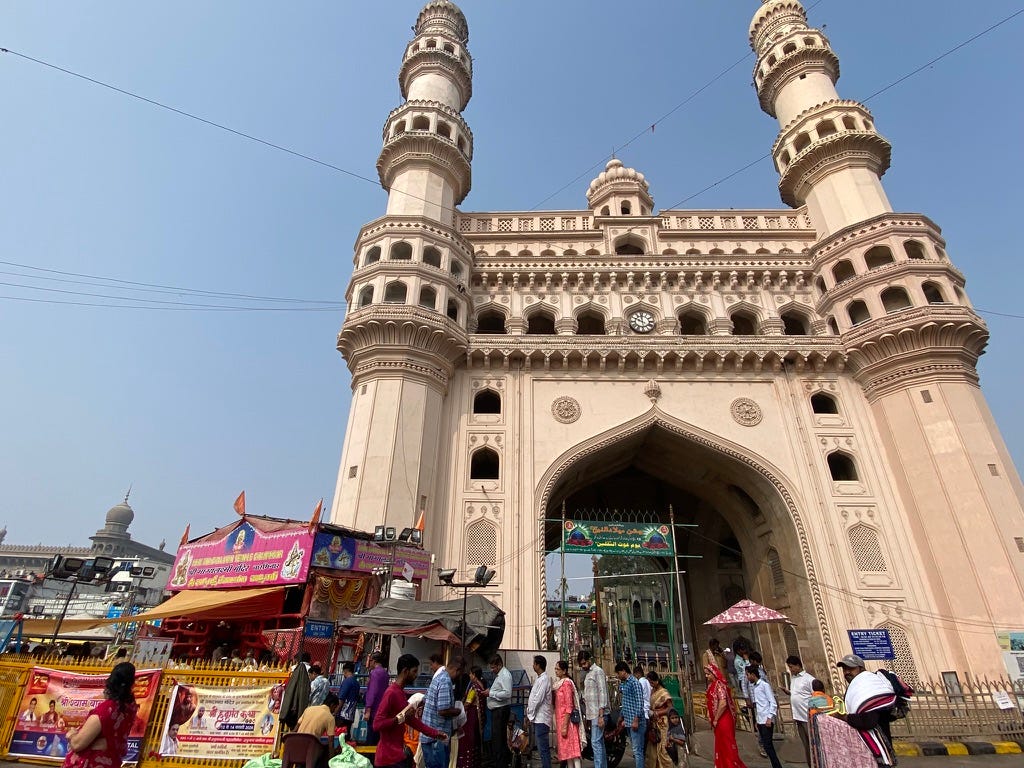
From Delhi I went southward to Hyderabad. The city had been ruled as a princely state during the colonial period. Centuries of Hindu-Muslim interaction resulted in a robust if finely balanced tehzeeb, or shared culture. Hyderabad was far away from the northern states, where hardened forms of modern Hindu and Muslim identity first developed. In 1948, military action took place when the Nizam, its ruler, refused to join the Indian republic.
Maybe we learn more about the nature of communal division from a child’s perspective than from that of yogis or politicians. In the words of Abdul Quddus Saheb, then a teenage musician:
The violence followed by those five days of invasion shattered our lives—took away the tehzeeb of our everyday lives.
Abdul also said:
In those days I would sing the songs of Muharram both in Urdu and Telugu. I was not even twenty and so enthusiastic about this performance as I strongly believed in its ability to connect Hindus and Muslims. There was no separation between Hindus and Muslims either in daily life, or during these religious events.
Another witness of the military action, Razia Begum, shared her adolescent memories only after repeated visits by a historian. ‘I didn’t think at any point of my lifetime I would be able to return to those sad memories of separation and hatred.’ She continued:
We suddenly began to realize that we were actually in the middle of new language—the language of hatred. Until then we were happy and our lives were peaceful, or at least, confined to our quiet homes.
Why should these categories be obvious? The notion that adults are capable of political decision-making, in contrast to children, can seem tenuous.
Sadly, the damage to the Hyderabadi tehzeeb after 1948 is far from the last time that trust has turned into distrust. Or to borrow a line from a short story by N.K. Swamy, how ‘a long-time friend now becomes a suspicious entity and a stranger too’. In old Delhi, locals told me that this mixed neighbourhood was less polarised than others. Everyone lives on top of each other, and livelihoods are intertwined. But any optimism about the social fabric was tinged with precariousness.
From the first calls for self-rule (swaraj) to the present day, Indian democracy has involved the search for a political self. Who belongs to the nation? A political scientist in Hyderabad talked about increasing numbers of nationalistic young men in his classroom. Managing volleys of jingoistic slogans is now part of his job. All this in a city that has been a leader in gender parity.
Some years ago over Zoom, I interviewed a high school student for a scholarship. She spoke about growing up in the aftermath of the 2002 Gujarat violence. The communal conflict killed over a thousand people and redrew neighbourhoods. Her relationship to schoolmates became thin as glass, as did her image of her own place in society. I thought of that conversation again in light of how young people’s attitudes can quickly harden. It’s not that they didn’t have to navigate differences in pre-1948 Hyderabad or pre-2002 Gujarat. It’s that received categories can so easily smother the intricate interplay between self-perception and social identity.
I’m writing this as I wait for the red-eye flight to get back for some time with my daughter. I’m reminded that the kind of dialogue that al-Biruni practised is something we experience in everyday life: encountering differences establishes the boundaries of the self. Hardening and rupture are often part of growing up. We can’t control this process in children, but we can attend to it. In doing so, we’re also rethinking our own attitudes.