
Drummin'
Music at the dawn of life

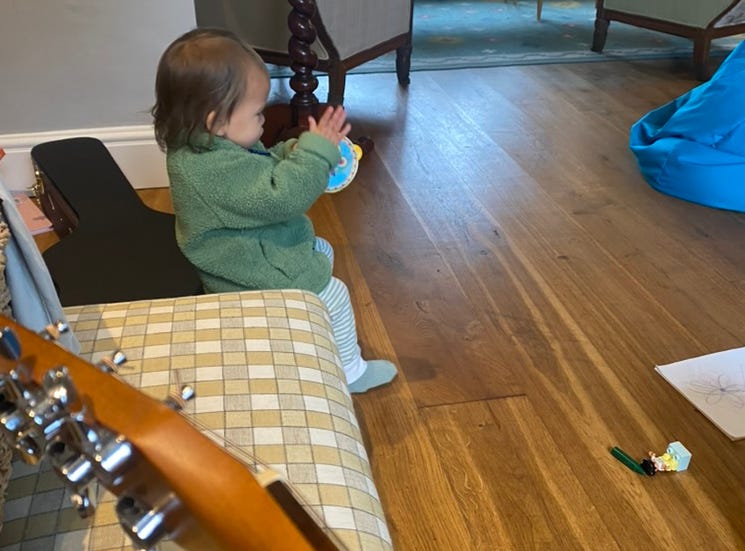
Once in a while, we all need to pause and get some music going. It might be your go-to playlist on the headphones, or making some noise on your favourite instrument, or singing your heart out in the shower. Then the day can keep going. It turns out that parenting isn’t so different from the rest of life.
The past few weeks have been trickier with obvious and non-obvious illnesses, the full bloom of toddler tantrums, and confusing attempts to communicate on the cusp of language. Connecting with her has been more difficult than usual. One exception has been music. It’s not just useful for specific tasks, like coaxing her to sleep or getting her to sit still for a meal. It’s also been one of the few things that help her reset when she’s emotionally overwhelmed. And it’s been one of the few things that spark joy when she’s calmed.
Her current preferred musical style is slap guitar. She claps along or joins with the tambourine. Or she does a whirling dance, or bounces on her knees. When learning about childhood milestones, I never registered jumping. For someone who can’t yet lift herself off the ground, bouncing is a fun substitute. She’s got a great sense of slapstick humour about music. If toddlers were filmmakers, they’d probably be Charlie Chaplin. The question is how to keep the comedy alive inside them.
Last week, I went to a headline show with our friend Michael’s band, My Mercury. The rarity of going out after ‘bedtime’ accentuates the special treat of live music. What’s better than listening to your friends make music then chatting between sets in the pub garden on an autumn night? The band played their single that they’d released just the day before. Geezer that I now am, I couldn’t help thinking about going to shows with my kid when she’s older, or better yet, going to her shows. Wonder what kind of band she’ll be in.
More than my own experience, Ren’s responses have made me think about the psychology of live music. Songs on the speakers are better than nothing. On car rides we’re graduating from nursery rhymes and she’s enjoying a playlist my brother made for her. But what really reaches her is music that’s made right there in the room. I’d guess that it has something to do with how genuine play involves experimenting with cause and effect. It’s easier to tap into that when music is a full-bodied experience. As I told Michael after the show, the best thing was seeing him activate.
In the few years before I became a parent, life took different turns and I spent less time playing music than in any period I can remember. Now most of the live music in my life is whatever we make at home. Especially when she was younger, there was a lot of singing her to sleep. In the middle of the night, I’d find myself wondering how music interacted with her consciousness. What did moving pitches around in this or that direction do? Why did singing at a high or low register have different effects? And what came first, music or language?
A certain Charles Darwin asked himself some similar questions almost 200 years ago. With the difference that he was delirious from seasickness rather than sleep-deprivation. From Plymouth, a few hours’ drive from where we live, he set sail on the HMS Beagle in 1831 to observe the world. He developed the idea that humans share fundamental intuitions with most animal species. That includes musical intuitions, which he believed to be continuous with ‘songs’ from the smallest bird to the largest whale. He suspected this had to do with the origins of language. He scribbled in his notebooks:
did our language commence with singing—is this the origin of our pleasure in music—do monkeys howl in harmony?
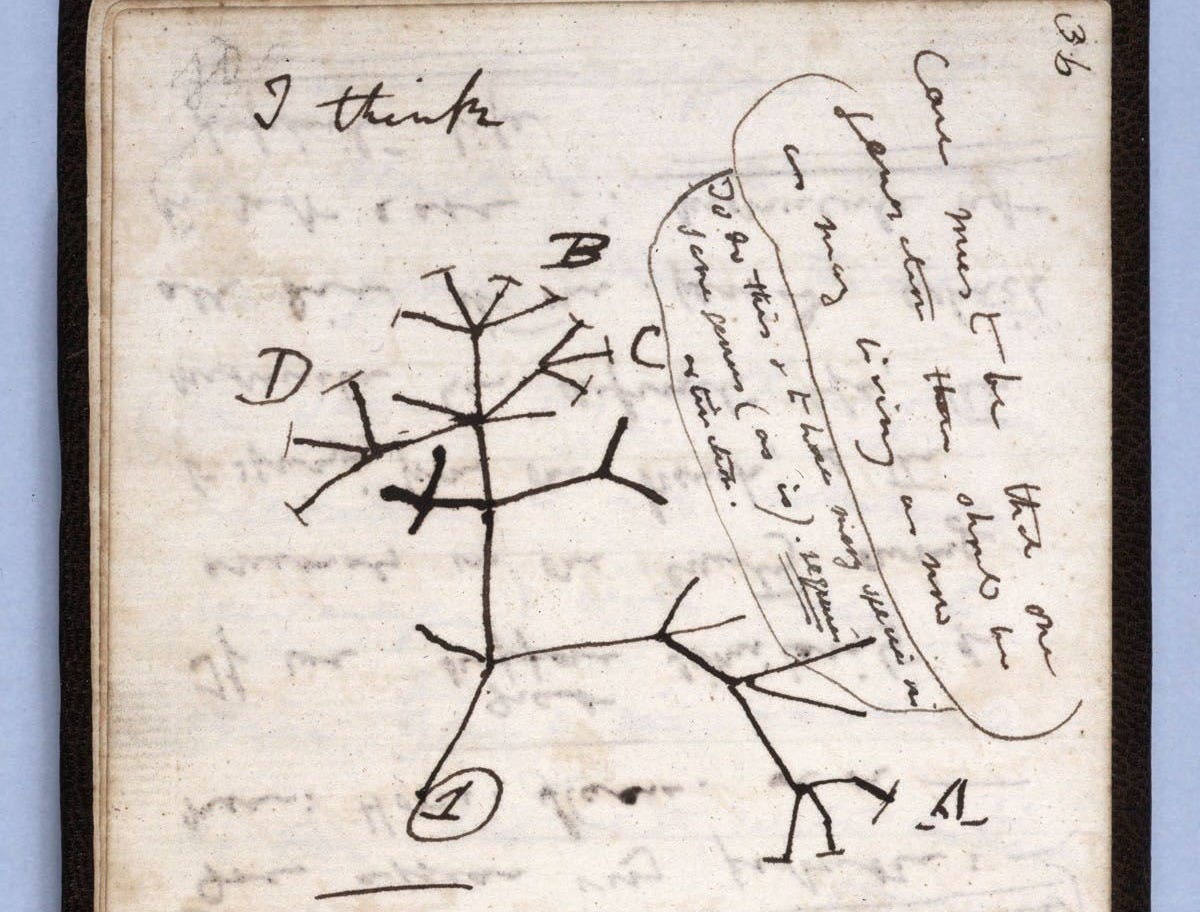
Darwin took a few decades to think through these revelations, which were published in 1871 as The Descent of Man. The ‘very ancient arts’ of music, dance, song and poetry must have been part of human history ‘at a very remote period’, he wrote. His claim was that music came before language. He was arguing against seeing music as an accessory by-product of speech, what researchers today call the ‘auditory cheesecake’ view of music. Contemporary neuroimaging techniques show how shared neural mechanisms underlie both music and language, though we’re still hazy on the details of their earliest co-evolution. When observing my daughter, I’ve been thinking about this interplay as much as I’ve been tracking the acquisition of words. As far as I can tell, babies don’t just respond to music. From the start, they put rhythm and pitch into their babbling.
Archaeologists tell us that the origins of instrumental music go back at least 40,000 years, when rhythm and pitch had become integrated. In 1995, a team unearthed a ‘Neanderthal flute’ from 60,000 years ago. The experts still debate whether this piece, made from the thighbone of a bear, was used to play music. If it was, that suggests a period of music history before Homo Sapiens became the only human species on the planet.
For all his adventures, Darwin had a surprisingly domesticated view of what music does: ‘Music arouses in us various emotions, but not the more terrible ones of horror, fear, rage, etc. It awakens the gentler feelings of tenderness and love.’ This seems misleading on a key point. Music transports. That’s why it can be a thread to draw a toddler out of a tantrum. It’s also why music can open up whole worlds of the imagination, some of which are unfamiliar and even frightening.
The story of the Pied Piper is probably based on a real event in 1284, when about 130 children vanished from the German town of Hamelin. The forces that draw people—including children—into the world often don’t fit into neat schemes. Darwin was right when he wrote that the faculty of music-making ‘must be ranked amongst the most mysterious’.
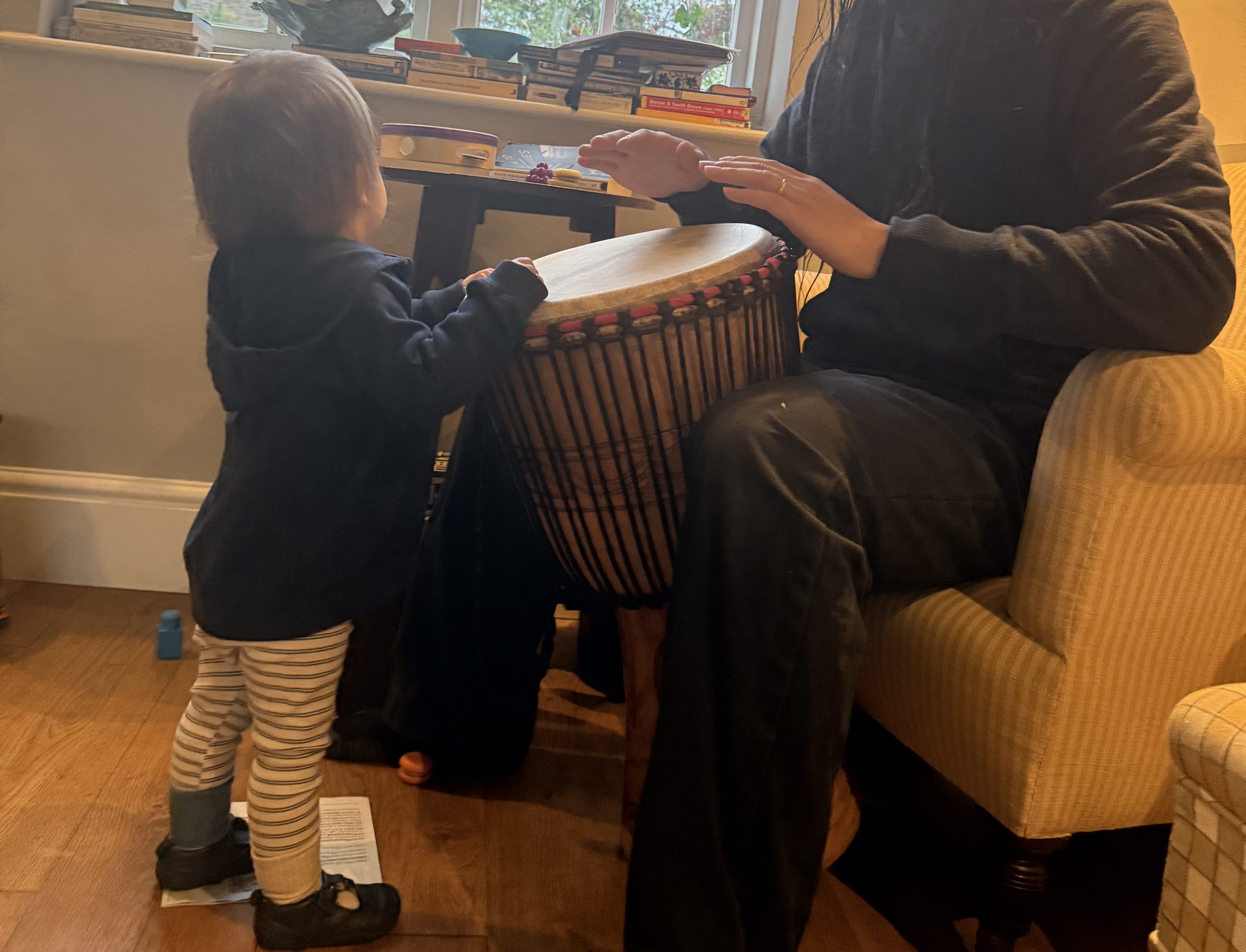
Almost every morning, Ren goes into the living room and plays a few beats on our djembe. I like to think that this ritual is for her what my first cup of coffee is for me. There are many stories behind why the djembe became her ‘first’ instrument. One of them is that I took lessons many years ago in Hong Kong. I was 16, tired of the city and tired of school. Every Sunday, I took a ferry out to Lamma Island and played the djembe with Makha Diop.
Makha lives on Lamma because it reminds him of where he grew up: Gorée Island in Senegal, just off the coast of Dakar. The djembe was part of community life, but he only started playing ‘properly’ at 15. His mother wasn’t too keen on drumming—she didn’t see a future in it. He’s now taught the djembe in Hong Kong for over two decades. He tells me that he especially likes teaching kids and giving them a shared moment with their parents. It’s one of the few ways for them to step away from their devices.
During covid, Makha founded a music and culture association called Sankofa. Too many people badly needed a space to connect with themselves and with other people. The word Sankofa, which means ‘to retrieve’, comes from the Ghanaian Akan language. It’s associated with a proverb: ‘go back to move forward’. Makha says that the concept isn’t just about going back in historical time. It’s also about going back to the psychological roots.
Djembe music is decisively joyful. Gorée Island, a centre of the transatlantic slave trade, has a grim history. Makha’s interpretation of Sankofa helps me understand how these facts coexist. The past is there as a thick web of traditions to draw from. It is not there to defeat us. There are many reasons not to focus on joy when looking out at the world today. My daughter will have many years to seek answers in music for grief, anger and sorrow. But if music can start by fuelling her internal joy, that feels like all we can ask for.
I enjoy projects. Like this newsletter. Or getting Ren to explore instruments, or developing ways to resolve emotional difficulties with her. But music and parenthood are alike in that they are ultimately not projects. They are forms of connection.
We know from adult life how people can share amazing experiences of music without a common language. The layers of expression in music remind me that parenthood is about making shared meaning. The human desire to connect always seems to exceed what we can put into words.
It may seem like toddlers, more than the rest of us, live in the zone between verbal and non-verbal communication. My take is that we might compartmentalise these channels as adults, but the zone in between never disappears. In fact, I love that zone. It is ancient. Each moment of making music is an echo of the dawn of life.
p.s. As this immortal rendition of the Anpanman theme song suggests, we have every reason to take kids’ music seriously.