
Before the male breadwinner
A glimpse of 17th century London

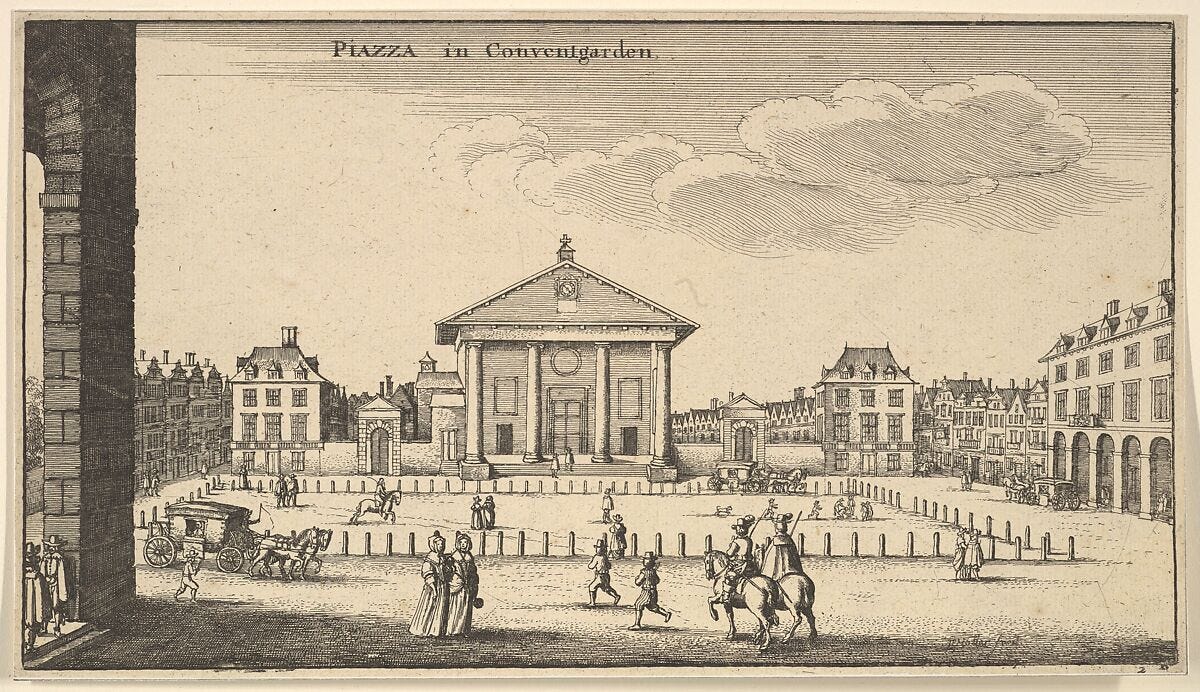
Every few weeks we come to London, though we aren’t here as much as we were before having a kid. Christmas markets help with the challenge of entertaining a small child on dark winter days. It’s equal parts touching and amusing to see parents’ desperate attempts to keep the kids wrapped up and content. I notice many more dads around over the holiday period. That’s nice, but also says something about the rest of the year.
Parenthood comes with questions about the gender division of labour, something I’m planning to write about more in 2026. In what direction are we moving? What would it take to move past the male breadwinner model? This instalment is to get the cogs turning.
Yesterday I took Ren for the first time to Covent Garden, following the Christmas lights. Around the corner and just over a century ago, Alice Clark was thinking about these questions at the London School of Economics. Clark, as her name suggests, came from the family that made the famous shoes. The LSE had women as both staff and students from its founding in 1895. It was open to unconventional people like Clark, who’d already been active for a couple decades as a suffragist and a businesswoman. Clark was also unconventional in how she approached the male breadwinner. In search for an alternative, she asked, what if we looked not forwards but backwards?
Alice Clark published The working life of women in the seventeenth century in 1919. Her intuition was to reject women’s work as a ‘static factor in social developments’. She interpreted the 1600s as a transitional period towards this later paradigm of the male breadwinner. Prior to this transition, women were involved across industry and agriculture. The home was a central unit of shared work, which gave women a strong and relatively equal position in this pre-capitalist system.
This stood in contrast to industrial society, where men worked outside the home and women were reduced to unpaid domestic labour. Later studies stylised Clark’s hypothesis as a u-shaped curve—from a maximal rate of female economic participation around 1700, to a reduction during industrialisation, and climbing back to pre-industrial levels only in the second half of the 20th century.
To ask whether this picture holds up for 17th century London, we need to sweep away some cobwebs. The documentation shows a heavy bias towards recording women’s marital status over their occupational status. Concepts can be misleading when projected back in time—take the title ‘Mrs’, which wasn’t exclusively about marriage but referred to social position, and the possession of capital in particular. And then there’s a question of how to reconcile different sources. A sample from Christ’s Hospital tells us that between 35% and 59% of married women worked in the same business as their husbands, whereas the number was 15% in court records and 17% in criminal records.
‘Housewife’ is one of the most revelatory concepts upon scrutiny. ‘Housewifery’ was continuous with what Clark called ‘domestic industry’, which included the production of goods by the family for sale or exchange. Women owned and ran ‘beerhouses’, they were part of craft guilds, and they worked in trades from pawnbroking to medicine. Domestic servants were often involved in their employer’s livelihood—someone might go from performing ‘housewifery’ in an inn to ‘production’ by pulling pints. London also had a blurrier separation of work by gender than rural England.
In unified household economies, women played important roles even when these were unnamed, unlisted and uncompensated. Take the example of Elizabeth Jeake, married to a merchant called Samuel. The family traded in commodities like hops and flaxseed, which they transported to London markets. Elizabeth never engaged in paid labour and doted on their children—her ‘little tribe’, her ‘cubbs’ and her ‘two pair of illmatched clogs’, as she calls them. That didn’t stop her from having a central part in negotiating credit relationships, making purchase orders, giving instructions to contractors and gathering investment information. As Samuel wrote to her in 1697 after a successful flaxseed purchase: ‘you do manage it so well that I cannot do better.’ There simply wasn’t a firm division between the household and the business.
The phenomenon of ‘housewifery’ raises more basic questions about how we understand work. In The Wealth of Nations, published in 1776, Adam Smith formulated one of the most consequential ideas in economics when he distinguished between productive and non-productive labour. Productive labour went towards creating sellable commodities, whereas non-productive labour resulted in ‘services which perish generally in the very instance of their performance’. Smith’s aim was to ask why some countries prospered more than others, but his idea swept care work into the non-productive basket. Without intending to, the great 18th century economist made invisible dynamic aspects of the 17th century and paved the way for 19th century ideologies of ‘separate spheres’ for men and women. We’re still recovering from the power of his ideas.
Clark’s hypothesis prompted people to ask how professions became segregated. Medical intervention later became masculine as a rule, but in this period there were domains of female authority. Until the 1720s, midwives were licensed through the church and exchanged knowledge through this system. This came to an end when midwifery became a male trade by the mid-1700s. The business of feeding people is another arena of change. Women had been dominant in brewing beer and making cheese, but this was on its last legs by the 17th century. We still don’t know exactly why.
We do know more about how women managed assets. This offers a different angle onto the extent of relative equality from standard metrics of labour participation. Consider Elizabeth Carter and Elizabeth Hatchett, who lived on Bell Alley in the City in the late 1600s. A court case revealed that the Elizabeths didn’t just manage their households’ ‘stuff’. They also worked together as pawnbrokers and provided credit lines all around the city, even south of the Thames. In other words, these women weren’t separate from the commercial economy but enabled it to function. There are two points to bear in mind about the laws of ‘coverture’ that restricted women’s ownership of property. The first is that the laws very much mattered. Unlike most European countries, England didn’t require a legal guardian for single women, including widows. The second is that even those women subject to coverture laws often found ways to sidestep these obstacles.
What should we make of the fact that so many 17th century Londoners worked in family businesses? After domestic service, the most common category of work for women was making and mending clothes. London specialised in gold and silver lace, and high-quality linen. There’s something to be said for flexibility. I’m reminded of my maternal grandmother, who switched from shift-work in a garments factory to piece-work at home when she had young children. And there’s something to be said for direct learning within the family, whether from parents or siblings. At the same time, ‘family industry’ comes with pressures, as told in this lace-making song collected from a later period:
One pin have I done to day
What do you think my mother will say?
… when she knows I’ve done no more.
She’ll take and turn me out of doors.
Never let me come in any more.
I’m skeptical about children’s flourishing in household economies, but I’m also not sure about the compartmentalisation of work and home in modern life.
Taking a step back—if industrialisation disrupted these patterns of 17th century life, how do we tally the gains and losses? Just a couple miles from where Alice Clark wrote her classic book, Ivy Pinchbeck taught at Bedford College near Regent’s Park, which later merged with Royal Holloway. Pinchbeck documented the increased dependence of women on male breadwinners after the 17th century. But she thought this also came with benefits, including leisure time. She also argued that when women started participating in wage labour, they were freed from domestic supervision and eventually gained greater rights. The many interpretations of ‘disruption’ reflect the many ways to seek equality. And there’s another approach that pushes against Clark’s picture more fundamentally by proposing a ‘patriarchal equilibrium’ that rides the waves of historical change.
Golden age thinking is limited for these and other reasons, but it can throw up questions for our own time. These pictures from the 1600s show just how integrated motherhood was with other social roles, contrary to the later idealisation and separation of domestic femininity. As for the men, how do we tell the story of their withdrawal from the home as a site of work? In searching for alternatives, a first step is seeing the cornerstones of present arrangements as flotsam from forgotten pasts. I can see why Clark looked backwards to reimagine the patriarchal norms of her Victorian upbringing—her present day—as artefacts of a contained, passing moment.
A simple idea threads through the past century of research: when people do many things in life, they probably are many things at once. Historians began rediscovering these 17th century stories when they focused on tasks rather than identities. When tracking shifting divisions of labour today, we should remember this intuition. The last few instalments of this newsletter were about identity. But focussing too narrowly on that concept obscures what people actually spend their time doing, and how freedom in one sphere of life depends on all the others too.